
TL;DR

Get everyday helpers delivered free with Prime
- Fast, free delivery on millions of items
- Prime Video, Amazon Music and more included
- Member-only deals all year
A Zhangjiajie guide described planning a 12-day trip for a 77-year-old American traveling alone, using lifts, cableways and park buses to reduce strenuous stair climbs. The account also notes limits: some summit paths have steps, and the full route may not suit wheelchair users. It is a personal travel report, not an official accessibility assessment.
A Zhangjiajie guide says a 77-year-old American traveling alone was able to visit the area’s famous sandstone viewpoints with fewer strenuous climbs by using the Bailong Elevator, cableways and park buses. The account describes one visitor’s itinerary, not an official assessment of access across the park, but it shows how route planning can affect whether older travelers can reach some of its best-known sights.
The guide, who grew up in Zhangjiajie and says he began leading tours in 2016, wrote that the traveler had contacted him two months before her trip. She prepared a day-by-day itinerary and sent a list of 26 requirements, including that every cableway, lift and escalator be incorporated. She was staying near the entrance to Wulingyuan, the park area, rather than in the city. The guide said this reduced daily driving and allowed for later starts and earlier returns.
On her first morning, the pair went to Yuanjiajie, a high plateau known for views of the sandstone pillars. Rather than hike up from the valley, they rode the Bailong Elevator, an outdoor sightseeing lift built against a cliff. The guide described the ride as taking a little over a minute, followed by an eco-bus journey and walks along paved routes to viewpoints. The visitor recognized one of the formations as the “Hallelujah Mountain” associated with the film Avatar; the guide says the area is widely linked to the movie’s floating mountains.
They used buses between viewpoints and descended on the Tianzi Mountain cableway a little after 3 p.m., returning to the hotel by about 4 p.m. The guide said he chooses an early descent rather than relying on a final ride because operating hours can depend on the day’s crowds and park decisions. He also described adapting other stops: taking a short section of the Golden Whip Stream rather than walking its full route of more than seven kilometers, and choosing a boat trip on Baofeng Lake instead of Yellow Dragon Cave, which he said has many steps. The traveler had requested vegetarian food and breakfast only, and the guide said the plan followed those preferences.
Access Depends on Route Choices
The account matters to travelers who may assume that a mountain destination requires climbing every staircase to see its main scenery. In this case, mechanized transport made some headline viewpoints reachable without a long ascent on foot. That does not mean the park is step-free or that every visitor can complete the same itinerary: the guide says the summit viewing trails still include many steps, and the amount of walking between transport stops remains relevant.
For older visitors, people with limited stamina and companions planning a trip, the report underscores the value of checking individual routes rather than relying on broad descriptions such as “accessible.” Lodging near a gate, allowing time for rest, confirming the day’s transport arrangements and choosing which sections to walk can shape the experience. The guide’s advice to descend early also reflects a practical concern: a plan dependent on the last lift or cableway may be vulnerable to changes in operating arrangements.
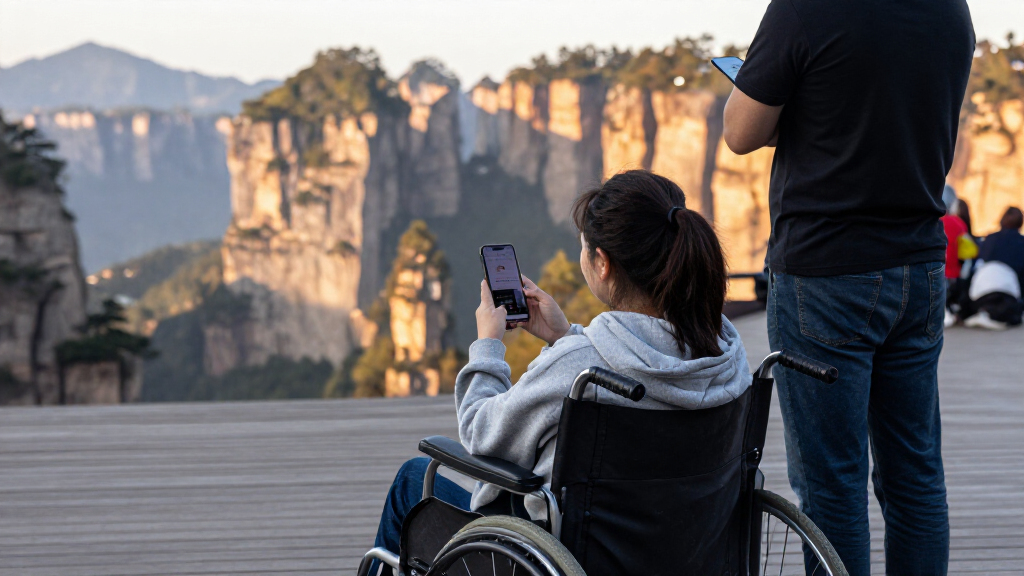
The source also draws a distinction between access to a viewpoint and access to a complete route. The guide says he has led wheelchair users and that buses, lifts, cableways and level paths can be used, but he cautions that steps on summit trails make pushing a wheelchair difficult. That qualification is important: reaching selected scenery by transport is not the same as having an uninterrupted accessible route throughout the park.
Zhangjiajie Bailong Elevator tickets
As an affiliate, we earn on qualifying purchases.
As an affiliate, we earn on qualifying purchases.
The Transport Behind the Viewpoints
Zhangjiajie’s Wulingyuan area is known for tall sandstone pillars and elevated viewpoints. The source report connects the scenery to the popular “Avatar mountains” description, while its practical focus is how visitors move between the valley and the higher viewing areas. The Bailong Elevator takes visitors from the valley toward Yuanjiajie, and eco-buses connect stops within the park. The guide’s account says cableways can also help visitors avoid walking the entire way up or down.
The report separately discusses Tianmen Mountain, near Zhangjiajie city, which has a large natural arch known as Tianmen Cave. The guide says outdated advice may tell visitors to take a cable car directly from the city, but that the long cableway no longer carries passengers. In the arrangement he describes, a ticket is checked at the mountain gate, an express cableway takes visitors to the square below the cave, and escalators inside the mountain continue toward the summit. A further five-stage escalator serves the steep approach to the cave, according to the guide.
Other attractions in the traveler’s plan included the Grand Canyon Glass Bridge. The guide said her ticket covered both the canyon and bridge, while whether she descended to the canyon floor would depend on how her legs felt. This was a decision planned for the day, not a confirmed account of what she ultimately did.
““So this is the Hallelujah Mountain from Avatar.””
— The 77-year-old traveler, as quoted in the guide’s account
accessible cableway for mountain parks
As an affiliate, we earn on qualifying purchases.
As an affiliate, we earn on qualifying purchases.
What the Account Cannot Confirm
The source is a guide’s personal account of one visitor’s trip, rather than a park-issued accessibility guide or an independent inspection. It does not provide a trip date, the visitor’s full mobility needs, current facility specifications, or measurements of walking distances and gradients between each stop. The guide’s description cannot establish that the same routes or services will be operating for every visitor on another day.
The report also does not say whether the traveler completed the later visits to Tianmen Mountain, the Glass Bridge or the canyon floor. Her decision about the canyon descent was still dependent on how she felt. Current operating hours, ticket conditions, closures and access arrangements are not independently confirmed in the account, and should be checked with the relevant attractions before travel.
For wheelchair users, the guide says some transport and level paths are usable but does not claim the full viewing route is accessible. Details such as step-free connections, accessible toilets, transfer assistance and the suitability of particular paths remain unspecified. Travelers with specific access requirements would need current, route-level information from operators before deciding what is feasible.
As an affiliate, we earn on qualifying purchases.
Check Routes Before Traveling
The account’s practical next step for prospective visitors is to build an itinerary around the transport available on each day, while leaving room to shorten or change walking sections. Travelers should confirm current lift, cableway, bus and escalator operations with park or attraction operators, especially before planning a descent around a particular ride or booking a tight schedule.
Visitors who need mobility support should ask for details about the exact route between transport stops and viewpoints, including steps, surface conditions and distance. The guide’s account suggests treating the canyon-floor walk as a separate decision rather than assuming that buying a combined ticket means every part of the attraction is manageable. No follow-up on the traveler’s later itinerary or the outcome of those visits was included in the source report.
wheelchair accessible sightseeing tours
As an affiliate, we earn on qualifying purchases.
As an affiliate, we earn on qualifying purchases.
Key Questions
Can visitors reach Zhangjiajie’s main viewpoints without hiking all the way up?
The guide says visitors can use the Bailong Elevator to reach the Yuanjiajie area and park eco-buses to move between stops. Walking is still required between some stops and viewing platforms, and conditions may vary by route and day.
Does the report say Zhangjiajie is fully wheelchair accessible?
No. The guide says buses, cableways, the elevator and some level paths can be used, but also warns that summit viewing trails have many steps and can be awkward for wheelchair users. The report does not assess every route or facility.
What did the guide recommend for avoiding long stair routes?
For the visitor described, the guide used lifts, cableways and buses, shortened the walk along Golden Whip Stream, and substituted a Baofeng Lake boat ride for Yellow Dragon Cave. These were choices for her itinerary, not a universal route plan.
Is the old cable car from Zhangjiajie city to Tianmen Mountain still operating?
The guide says the long cableway from the city no longer carries passengers and describes a route using an express cableway and mountain escalators. Because the account does not give a publication date or current operator confirmation, travelers should verify the latest arrangements before going.
Did the traveler visit the Grand Canyon floor and Glass Bridge?
The report says her later itinerary included the Glass Bridge and a ticket covering the canyon, but whether she would descend to the canyon floor depended on how her legs felt. It does not confirm what she ultimately did.
Source: rss
Halloween Picks
halloween
As an affiliate, we earn on qualifying purchases.