
TL;DR

Get everyday helpers delivered free with Prime
- Fast, free delivery on millions of items
- Prime Video, Amazon Music and more included
- Member-only deals all year
Manual wheelchairs are lightweight, affordable, and great for indoor use if you have good upper body strength. Power wheelchairs offer independence for those with limited strength or outdoor needs but come with higher costs and maintenance. Your choice depends on your mobility level, environment, and budget.
Imagine trying to keep up with your daily errands, or even just getting around your own home, without enough strength or endurance. That’s where the right wheelchair can make all the difference. But choosing between a manual and a power wheelchair isn’t just about price or features — it’s about what fits your life and keeps you moving confidently.
In this guide, you’ll find out exactly how these two options stack up. From ease of use and physical effort to outdoor versatility and long-term costs, we’ll break down what matters most. Because your independence deserves a choice that truly supports your everyday needs.
Your physical strength and daily activities determine whether a manual or power wheelchair suits you best.
Manual chairs are budget-friendly, lightweight, and easy to transport, ideal for indoor or short outdoor trips.
Power wheelchairs offer greater independence for outdoor use and limited strength, but come with higher costs and maintenance.
Consider future needs and environment when choosing—modern lightweight power options are increasingly portable.
Proper assessment and training ensure safety and comfort, regardless of which wheelchair type you select.
Manual vs Power Wheelchairs: Which Fits Your Life
TL;DR: Manual wheelchairs are lightweight, affordable, and ideal for indoor use when upper body strength is strong. Power wheelchairs reduce physical effort, expand outdoor range, and support users with limited strength, but they bring higher costs, transport planning, and maintenance.
$100-$1,000
Lower upfront cost, fewer moving parts, and simpler upkeep make manual chairs the budget-friendly baseline.
$1,500-$30K+
Power mobility can unlock independence, especially outdoors, but batteries, repairs, and coverage matter.
The right chair is not just a device choice. It is a daily energy, access, and confidence choice.
Strength
Manual chairs work best when self-propelling feels sustainable, not exhausting.
Indoor / Outdoor
Smooth floors favor manual use; uneven sidewalks often favor power support.
Fold vs Lift
Manual chairs are easier to fold and store; power chairs may need ramps or lifts.
Fit First
Professional assessment and training improve comfort, safety, and long-term use.
Choose by how you actually move.
Price and features matter, but the strongest decision comes from mapping the chair to your routine: rooms, sidewalks, vehicles, errands, endurance, support, and future needs.
Light, simple, portable
Best for users with reliable upper body strength, mostly indoor routes, short outdoor trips, and frequent car transport.
Range without strain
Best for limited arm strength, longer outings, outdoor hobbies, uneven ground, and conserving energy for the day itself.
Plan for change
Lightweight power models, add-on assists, upgraded seating, and future replacements can shift the best answer over time.
What is the real difference?
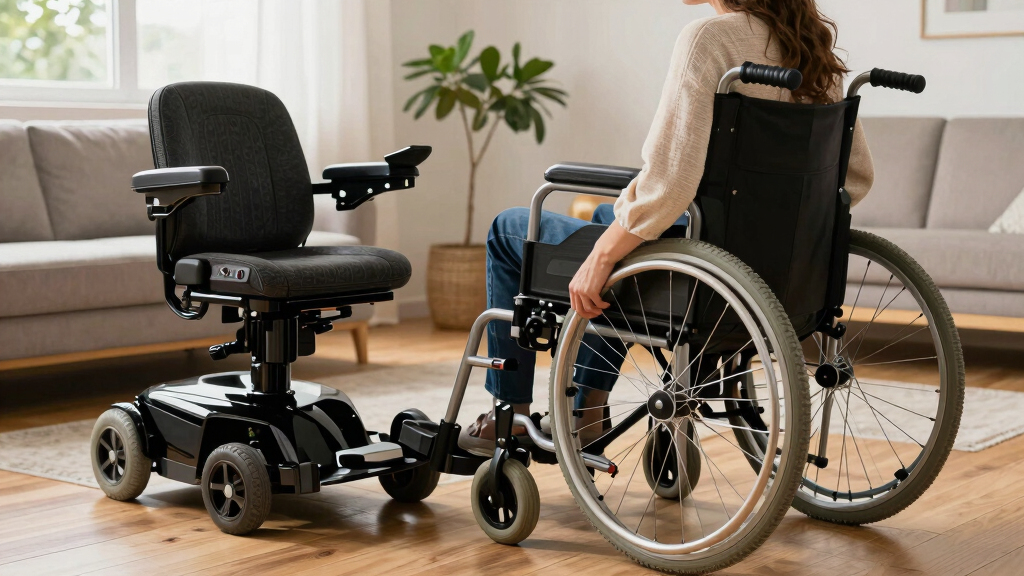
Manual and power wheelchairs solve different mobility problems. The table below highlights the practical tradeoffs most people feel day to day.
| Feature | Manual Wheelchair | Power Wheelchair | Fit Signal |
|---|---|---|---|
| Weight | ✓Lightweight, often under 30 pounds | ~Heavier, often 100+ pounds | Manual wins when lifting and trunk storage matter most. |
| Cost | ✓$100-$1,000 typical range | ~$1,500-$30,000+ typical range | Insurance and provider documentation can change the real cost. |
| Physical Effort | ~Requires upper body strength and endurance | ✓Joystick or alternative controls reduce strain | Power helps preserve energy when propulsion causes fatigue. |
| Outdoor Use | ~Works best on smooth, predictable surfaces | ✓Handles uneven ground and obstacles better | Outdoor distance and terrain are major deciding factors. |
| Maintenance | ✓Cleaning, tire care, and occasional adjustment | ✗Battery charging, repairs, and service planning | Power mobility brings more independence and more upkeep. |
The hidden cost is energy.
A manual chair can be affordable and freeing when propulsion feels natural. If it creates fatigue, pain, or avoidance, the long-term cost may show up as fewer outings, less social time, or injury risk.
Cost spectrum
Manual wheelchairs usually sit in the lower-cost zone. Power wheelchairs span a much wider range because motors, batteries, seating systems, controls, suspension, and service needs vary dramatically.
Manual long-run costs
Fewer parts, simpler repairs, and lower purchase prices. Watch for wear, tire condition, cushion fit, and whether physical strain increases over time.
Power long-run costs
Higher upfront investment plus batteries, charging, service, and transport equipment. Insurance coverage may offset costs when medically recommended.
A practical path to the right chair.
Use this sequence before buying, upgrading, or requesting coverage. It keeps the choice grounded in function instead of guesswork.
Map your day
List home routes, errands, surfaces, transport, and distance demands.
Check strength
Ask whether self-propelling protects independence or drains it.
Price the whole life
Compare purchase price, repairs, batteries, lifts, and insurance help.
Get fitted
Professional assessment improves posture, comfort, control, and safety.
Train and test
Practice braking, turning, slopes, transfers, controls, and tight spaces.
Match the chair to your life, not the other way around.
Modern wheelchair options are more customizable than ever, from lightweight frames and quick-release wheels to foldable power models, smart controls, suspension, and tailored seating.
You have strength, short routes, and storage needs.
- Daily spaces are mostly indoors or smooth.
- You can self-propel without pain or major fatigue.
- You need easy folding, lifting, and car trunk storage.
You need distance, terrain support, or energy savings.
- Outdoor routes, slopes, and uneven surfaces are common.
- Upper body strength or endurance is limited.
- Independence is worth the added cost and maintenance.
What’s the real difference? Manual vs Power Wheelchairs — a quick comparison
| Feature | Manual Wheelchair | Power Wheelchair |
|---|---|---|
| Weight | Lightweight, often under 30 pounds | Heavier, typically 100+ pounds |
| Cost | $100–$1,000 | $1,500–$30,000+ |
| Ease of Transport | Folds easily, fits in car trunk | Requires special vehicle or lift |
| Physical Effort | Requires upper body strength to self-propel | Operated via joystick or switch |
| Outdoor Use | Suits smooth surfaces, limited rough terrain | Handles uneven ground, outdoor obstacles |
| Maintenance | Minimal, mostly cleaning | Battery charging, occasional repairs |
This table highlights core differences — from weight and cost to how easy they are to handle. Think about where you’ll use your wheelchair most often when weighing these features.
manual wheelchair lightweight portable
As an affiliate, we earn on qualifying purchases.
As an affiliate, we earn on qualifying purchases.
Which wheelchair suits your lifestyle? Match your needs with the right type
Think about your daily routine. Do you spend most of your time indoors or outdoors? If you’re active, traveling often, or enjoy outdoor adventures, a power wheelchair might serve you better. It handles uneven terrain and reduces physical strain.
If your activities are mostly indoors, with smooth floors, and you have good upper body strength, a manual wheelchair can be perfect — lightweight, easy to fold, and less costly.
For example, Jane, who lives in a city apartment and mainly navigates hallways and elevators, finds her manual wheelchair lightweight enough to fold and carry. Meanwhile, Mike, with limited arm strength and outdoor hobbies, benefits from his power wheelchair’s ability to navigate parks and uneven sidewalks with ease.
As an affiliate, we earn on qualifying purchases.
Physical strength and effort: Can you handle a manual wheelchair?
Manual wheelchairs demand physical effort — especially if you plan to self-propel. The importance of physical strength here isn’t just about the ability to move; it directly impacts your independence, energy levels, and overall quality of life. If you have strong arms and good endurance, you can navigate your environment with ease, enjoying greater control and flexibility. However, if your strength is limited, pushing yourself can lead to fatigue, discomfort, or even injury over time, which might limit your mobility and willingness to go out frequently.
Choosing a manual wheelchair when your strength is marginal can unintentionally lead to frustration or reduced activity levels. Conversely, opting for a power wheelchair can preserve your energy, allowing you to participate in more activities and maintain social engagement without physical exhaustion. The tradeoff is higher cost and maintenance, but for many, the increased independence and comfort justify these expenses.
Pro tip: Some manual chairs are designed with lightweight frames or quick-release wheels, making them easier to lift into cars or up stairs. These adaptations can help mitigate some effort required, but they don’t replace the fundamental need for adequate strength for regular self-propulsion.
manual vs power wheelchair comparison
As an affiliate, we earn on qualifying purchases.
As an affiliate, we earn on qualifying purchases.
Cost and upkeep: What’s really affordable in the long run?
Price tags tell part of the story. Manual wheelchairs typically cost between $100 and $1,000. They tend to have fewer parts that wear out, leading to minimal ongoing expenses—mainly just cleaning and occasional adjustments. Power wheelchairs, however, can cost from $1,500 up to over $30,000, and these higher initial costs are coupled with ongoing expenses like battery replacements, repairs, and sometimes more frequent professional maintenance. These costs can significantly impact your long-term budget and must be considered when making your choice.
Understanding the long-term financial implications is crucial. For instance, a manual wheelchair might seem cheaper upfront, but if you require frequent repairs or find yourself needing a more durable model, costs can add up. Conversely, investing in a power wheelchair might seem costly initially, but if it significantly enhances your independence and reduces other healthcare expenses related to fatigue or injury, it may be more economical over time.
Tip: Check your insurance coverage — many plans help offset the cost of power wheelchairs, especially if recommended by a healthcare provider. Also, consider the potential for future upgrades or replacements, and how those expenses fit into your overall budget.
As an affiliate, we earn on qualifying purchases.
Getting around: Portability and storage tips for busy lives
Manual wheelchairs fold easily, making them a practical choice for frequent travel or storage in tight spaces. Their lightweight nature allows for quick packing into car trunks or carrying onto buses and trains. This ease of portability means you can maintain an active lifestyle without worrying about cumbersome equipment. However, their portability is a double-edged sword if you have limited strength or need assistance, as lifting or folding might still be challenging without help.
Power wheelchairs, on the other hand, are bulkier and often require ramps or lifts to load into vehicles. While some newer models are lighter and foldable, they still tend to be heavier and more cumbersome to transport. This can limit spontaneous trips or require advanced planning, especially if you rely on public transportation or have limited assistance.
Consider your travel frequency, physical capabilities, and available support when choosing. If mobility and ease of transport are priorities, manual models excel; if independence in outdoor or long-distance travel is more important, investing in lightweight, foldable power options might be worthwhile despite their size.
Training and safety: What’s required to operate each type?
Manual wheelchairs require no formal training — just some practice to get comfortable with steering, braking, and maneuvering. Their operation relies on your physical coordination, so understanding how to lift, turn, and stop safely is essential. Proper technique reduces the risk of injury and ensures smoother navigation, especially in tight spaces or on uneven surfaces.
Power wheelchairs, however, do require some initial training. Most users undergo guidance on joystick operation, safety features, and emergency procedures. This training is critical because improper use can lead to accidents, especially when navigating slopes or crowded areas. Regular checks and maintenance are also necessary to ensure safety over time, such as verifying battery health and control responsiveness.
For example, Jamie took a short tutorial before using her power wheelchair outdoors. Now, she confidently navigates her neighborhood, knowing how to handle slopes, avoid obstacles, and use safety features. This training not only enhances safety but also boosts confidence, making the device truly serve its purpose of independence and mobility.
Tip: Always ask your provider about available training sessions and safety tips. Proper education is key to maximizing your device’s benefits and ensuring long-term safety.
Future trends: What’s new in wheelchair tech?
Recent innovations are transforming wheelchairs from simple mobility devices into smart, adaptable tools. Power models now feature Bluetooth connectivity, allowing users to customize controls, track usage, and even receive diagnostics remotely. Lightweight, foldable frames are becoming more common, making powered chairs easier to transport without sacrificing stability or features.
Advanced suspension systems are improving ride comfort on rough terrain, reducing vibrations and fatigue. Hybrid models are emerging that combine manual ease with powered assistance, giving users flexibility based on their activity or environment. Imagine a wheelchair that automatically adjusts its seat height for comfort or connects to your smartphone to alert you when maintenance is needed. These developments are making mobility devices more personalized, intuitive, and responsive to individual needs.
Staying informed about these technological advancements can help you choose a device that not only meets current needs but also adapts to future changes in lifestyle or health status. As innovation continues, the line between manual and powered solutions is blurring, offering more versatile options for users of all levels.
Frequently Asked Questions
Can I switch from a manual to a power wheelchair later?
Yes, many people start with a manual wheelchair and transition to a power model as needs change. Your healthcare provider can help assess when it’s time to upgrade and guide you through the process.How do I know if I need a power wheelchair?
If you experience fatigue, limited arm strength, or difficulty navigating outdoors, a power wheelchair can provide greater independence. A professional assessment can help confirm the best fit for your lifestyle.Are lightweight power wheelchairs portable?
Many newer power wheelchairs are designed to be lightweight and foldable, making them easier to transport in cars or on public transit. Check models carefully for weight and foldability features.What safety features should I look for?
Look for features like anti-tip wheels, easy-to-access controls, and stability systems. Proper training on operation is essential for safe use of either manual or power wheelchairs.Conclusion
Choosing the right wheelchair isn’t just about current needs — it’s about supporting your independence for years to come. Visualize your daily routines, environment, and strength, then pick the device that feels like a natural extension of your life.
Remember, the best choice helps you move confidently, comfortably, and with dignity. Every step forward is a step toward more freedom — so choose wisely, and keep moving.
Columbus Day / Indigenous Peoples' Day Picks
long weekend sales
As an affiliate, we earn on qualifying purchases.