TL;DR

Get everyday helpers delivered free with Prime
- Fast, free delivery on millions of items
- Prime Video, Amazon Music and more included
- Member-only deals all year
Rollators are wheeled, pushable devices with seats, suitable for moderate mobility needs. Walkers are more stable frames often used for severe balance issues. Both serve different lifestyles and safety requirements.
Choosing the right mobility aid can feel overwhelming. Is a walker enough, or does a rollator offer more convenience? The difference is more than just wheels—it’s about how you move through your day. In this guide, you’ll learn exactly what sets them apart, so you can pick the best support for your independence.
Whether you’re helping a loved one or reassessing your own needs, understanding these differences ensures safety, comfort, and confidence. Let’s break down the essentials, with real-world examples and practical tips, to clarify which device aligns with your lifestyle.
Walkers offer maximum stability, ideal for severe balance issues, but require lifting or stepping to move.
Rollators are pushable, lightweight, and include seats, making outdoor walking and resting easier for moderate mobility needs.
Modern features like foldability, ergonomic handles, and safety brakes enhance ease of use and portability.
Choosing between a walker and rollator depends on your balance, lifestyle, indoor/outdoor use, and comfort preferences.
Always consult a healthcare professional to match your specific mobility needs with the right device.
The right mobility aid is about how you move through the day.
Rollators are wheeled, pushable devices with seats for moderate mobility needs. Walkers are stable frames often used for severe balance challenges. The choice is not just wheels versus no wheels; it is a balance of support, energy, environment, and confidence.
of users in recent studies find rollators easier to maneuver than traditional walkers.
still provides the strongest support base for significant balance issues and post-surgery recovery.
adds wheels, brakes, storage, and a built-in seat for longer walks and easier rest breaks.
One anchors your steps. One rolls with you.
Both devices support independence, but they solve different mobility problems. A walker prioritizes maximum stability. A rollator prioritizes easier motion, rest breaks, and longer outings.
Stable frame support
A walker is a sturdy metal frame with four legs. It usually requires lifting or stepping forward, which creates a planted support base for people who need firm balance assistance.
Pushable wheeled aid
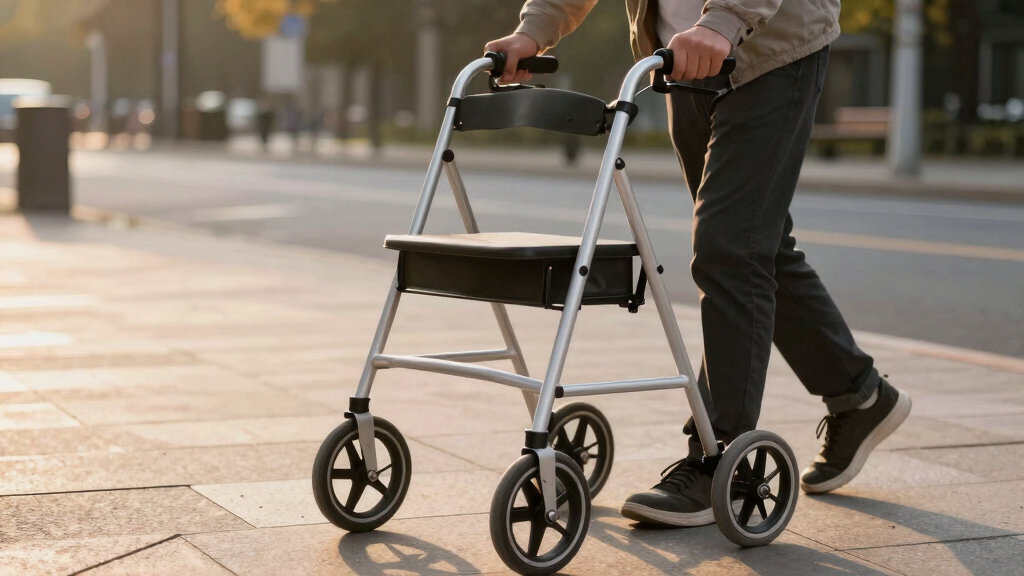
A rollator has three or four wheels, hand brakes, adjustable handles, and often a seat or storage pouch. It suits people who can walk but need support and rest options.
Safety before features
Convenience matters, but balance matters more. Severe balance challenges often call for a walker, while moderate mobility needs may benefit from a rollator.
Rollator vs walker comparison
The practical differences show up in movement, safety, features, portability, and cost. Use this table as a quick filter before speaking with a healthcare professional.
| Feature | Walker | Rollator | Best Fit |
|---|---|---|---|
| Mobility | Requires lifting or stepping to move | Pushes easily with no lifting needed | ~ Depends on strength and stamina |
| Stability | ✓ Maximum stability for severe balance issues | ~ Stable, but less supportive on uneven terrain | Walker for highest support |
| Features | Basic frame; some models have front wheels | ✓ Wheels, seat, brakes, storage, height adjustment | Rollator for convenience |
| Ease of Use | ~ More effort because lifting may be required | ✓ Push-and-go motion reduces fatigue | Rollator for longer outings |
| Best For | Severe balance problems, recovery, indoor support | Moderate mobility needs, outdoor walks, shopping | Match device to balance level |
| Portability | ✕ Often bulkier and less travel-friendly | ✓ Many fold flat for storage and transport | Rollator for travel |
How to narrow the decision
The safest choice comes from matching the device to balance, daily routes, fatigue, and professional guidance.
Balance
Severe balance issues point toward a walker because the support base is more stable.
Strength
Limited lifting strength may make a pushable rollator less tiring for daily movement.
Setting
Indoor routines often favor walkers; outdoor errands often favor rollators.
Rest
If frequent pauses matter, a rollator seat can make longer walks more realistic.
Fit
A clinician can check height, brakes, gait, posture, and fall risk before purchase.
Where each device performs best
Rollators win on maneuverability and comfort features. Walkers win on grounded support. The right answer is personal, not universal.
Maneuverability rating
Rollators are easier to push and steer for many users, especially across longer indoor routes, sidewalks, stores, and parks.
Support spectrum
A rollator can preserve activity and confidence, but a walker is usually the safer option when fall risk is high.
Choose by lifestyle, not just product features.
The best mobility aid is the one that matches real routines: doorways, sidewalks, fatigue, recovery goals, and how much support the body needs today.
Choose a walker when…
- You need maximum stability or have significant balance issues.
- You are recovering from surgery and need a solid support frame.
- Your daily movement is mostly indoors on smooth surfaces.
- You want a lower-cost device and do not need a built-in seat.
Choose a rollator when…
- You can walk independently but need extra support.
- You want to reduce fatigue during errands or outdoor walks.
- You benefit from a seat, brakes, storage, and adjustable handles.
- You need a foldable device for travel or easy storage.
Newer designs make both options easier to live with.
Recent advances focus on safer brakes, lighter frames, ergonomic handles, foldability, and more personal style. Some smart rollators are adding GPS tracking and fall detection, though these features are still emerging.
Can I switch between them?
Yes. Some people use a walker indoors for stability and a rollator outdoors for longer walks. A healthcare provider should confirm that both are safe for your gait and balance.
Are rollators safer?
Not automatically. Rollators are easier to maneuver, but walkers usually provide more stability. Safety depends on the user, terrain, device fit, and brake use.
What should I look for?
Check adjustable height, ergonomic grips, weight, foldability, brake control, seat comfort, and whether the device fits through your most-used spaces.
What exactly is a walker, and when should you choose one?
A walker is a sturdy frame, often made of metal, designed to stabilize your steps. It can be a simple, stationary frame or a model with small wheels on the front legs. Think of it as a reliable support system that stays rooted to the ground, requiring you to lift or step it forward.
For example, someone recovering from surgery who needs maximum stability might prefer a traditional walker. It offers a solid barrier against falls and is ideal for those with severe balance issues. If you’re navigating uneven terrain or need consistent support, a walker is your best bet.
Walkers are often used indoors or on smooth surfaces, but they’re also versatile enough for outdoor use if stability is your priority.
It’s important to recognize that while walkers provide excellent stability, they can be less convenient for quick movements or long distances because they require lifting or pushing, which might lead to fatigue over time. The tradeoff is between maximum stability and ease of mobility, especially relevant for users with significant balance concerns or limited strength.
As an affiliate, we earn on qualifying purchases.
What makes a rollator different, and who benefits most?
A rollator is a walker with wheels—usually three or four—that you push along as you walk. It often includes a built-in seat, so you can sit and rest whenever needed. Many come with handy features like brakes, adjustable height, and storage pouches.
Imagine strolling through a park, feeling the breeze, and knowing you can sit anytime. That’s the freedom a rollator provides. It suits people who can walk but want a little extra support and the option to pause or rest. For example, a person with moderate mobility issues might choose a rollator to stay active without fatigue setting in too quickly.
Modern designs are lightweight, foldable, and colorful, making them easy to carry and match personal style. They’re perfect for outdoor strolls, shopping trips, or long indoor walks.
However, while rollators are more maneuverable than traditional walkers, they may offer less stability, especially on uneven terrain. The tradeoff here involves balancing convenience and support: for users with mild to moderate balance issues, the ease of pushing and resting can greatly enhance independence. But for those with severe balance problems, a rollator might not provide enough support, and a more stable device might be necessary.
As an affiliate, we earn on qualifying purchases.
Rollator vs Walker: How do they stack up? Here’s a side-by-side comparison
| Feature | Walker | Rollator |
|---|---|---|
| Mobility | Requires lifting or stepping to move | Pushes easily, no lifting needed |
| Stability | Maximum stability, good for severe balance issues | Stable but less so, suitable for moderate issues |
| Features | Basic frame, sometimes with small wheels | Wheels, seat, brakes, storage, adjustable height |
| Ease of Use | Requires effort to lift and move | Push and go, more effortless |
| Best For | Severe balance problems, indoor use | Moderate mobility, outdoor and indoor use |
| Cost | $30–$100 | $100–$300 |
| Portability | Less portable, bulkier | Foldable, easier to transport |
Understanding these differences helps you weigh the tradeoffs: choosing a walker maximizes stability at the expense of convenience, while a rollator offers easier movement and outdoor versatility but may compromise some stability. The right choice depends on your specific needs, environment, and comfort preferences.
As an affiliate, we earn on qualifying purchases.
Choosing the right device: What factors really matter?
Picking between a walker and a rollator hinges on your mobility level, environment, and personal preferences. For instance, if you struggle with maintaining balance, a walker’s stability provides peace of mind. But if you want to stay active and enjoy outdoor walks, a rollator’s wheels and seat make it more practical.
Here are some quick tips:
- Assess your balance: Severe issues lean toward walkers because they offer maximum stability, reducing fall risk and providing a solid support base. If your balance is only mildly impaired, a rollator might suffice and offer more freedom of movement.
- Consider your lifestyle: Active outdoor enthusiasts benefit from the mobility and resting features of a rollator, which encourages longer walks and social outings. Conversely, if your routine is mostly indoors or on even surfaces, a walker may be more appropriate.
- Indoor use: Space constraints can influence your choice. Walkers tend to be bulkier and might be harder to maneuver in tight spaces, whereas foldable rollators are designed for easy storage.
- Ease of use: Pushable devices like rollators reduce fatigue and are easier to handle for many users, especially those with limited strength or joint issues.
- Budget: Basic walkers are more affordable but lack features like seating or brakes, which can add safety and convenience. Weigh the cost against your needs and preferences.
Always consult a healthcare professional—they can help evaluate your specific needs, test different devices, and recommend the best support to ensure safety and comfort.
stability walker for balance issues
As an affiliate, we earn on qualifying purchases.
As an affiliate, we earn on qualifying purchases.
Recent innovations making your choice easier
Technological advances have transformed mobility aids. Today’s rollators often feature lightweight materials like aluminum and carbon fiber, making them easier to handle. Some models include ergonomic handles and adjustable components that fit your height perfectly.
Smart features are emerging, such as GPS tracking or fall detection, although these are still in early stages. Plus, foldability has improved—many models now fold flat in seconds, perfect for travel or storage.
Design and style matter, too. Bright colors and sleek frames boost confidence and make the device feel less medical. In the end, modern features add convenience, safety, and a touch of personal style.
Understanding these innovations can help you choose a device that not only meets your functional needs but also enhances your confidence and independence. The goal is to find a balance between advanced features and ease of use, ensuring you get the most benefit from your mobility aid while maintaining your lifestyle and personal preferences.
Frequently Asked Questions
Can I switch between a walker and a rollator?
Yes, but it depends on your needs. Some people use both—walker for stability indoors, rollator for outdoor walks. Always check with a healthcare provider to ensure safety and proper support.Are rollators safe for outdoor uneven surfaces?
Rollators with larger wheels perform better on uneven terrain like gravel or grass. However, for very rough terrain, a sturdy walker or even a mobility scooter might be better. Test different models to find what suits your environment.What should I look for when buying a mobility aid?
Focus on stability, ease of use, weight, size, and comfort features like adjustable height and brakes. Prioritize safety and personal convenience—your daily walk depends on it.Can a rollator help prevent falls?
A rollator offers support and reduces fatigue, which can lower fall risk for moderate mobility issues. But proper training and fit are crucial—always practice and consult experts if unsure.How much do these devices typically cost?
Basic walkers start around $30–$100, while quality rollators range from $100–$300, depending on features. Investing in a well-made device can improve safety and comfort over time.Conclusion
Understanding the difference between a rollator and a walker is about matching support with your lifestyle. One offers rock-solid stability, the other freedom of movement and rest. Think about where and how you walk most—then choose the aid that supports your independence best.
Remember, the right device isn’t just a tool; it’s a step toward staying active, safe, and confident every day. Your mobility journey is personal—make it a confident stride.
Columbus Day / Indigenous Peoples' Day Picks
long weekend sales
As an affiliate, we earn on qualifying purchases.