
TL;DR

Get everyday helpers delivered free with Prime
- Fast, free delivery on millions of items
- Prime Video, Amazon Music and more included
- Member-only deals all year
At the HFSA annual meeting, researchers reported that the investigational PET/CT tracer 124I-evuzamitide detected cardiac amyloidosis in the phase III REVEAL study, with 93.5% sensitivity and 86.0% specificity. It identified early ATTR amyloidosis more often than bone scintigraphy, and Bayer said it plans to submit the tracer for regulatory approval. The study was single-arm, had limited follow-up, and does not establish how the test will perform in routine clinical practice.
An investigational PET/CT tracer detected cardiac amyloidosis with 93.5% sensitivity in the phase III REVEAL study and found early transthyretin (ATTR) cases more often than bone scintigraphy, researchers reported at the Heart Failure Society of America annual meeting. Bayer said it plans to submit 124I-evuzamitide for regulatory approval, though the results come from a single-arm study and the test’s performance in routine care remains unknown.
Among 170 people suspected of having cardiac amyloidosis, the tracer had 86.0% specificity, a 94.1% negative predictive value and an 84.7% positive predictive value, according to results presented by Mathew Maurer, MD, of Columbia University Irving Medical Center. Researchers reported similar performance for light-chain (AL) and ATTR amyloidosis. The diagnostic comparisons used expert reviews of clinical records as a reference standard, rather than a single uniform test for every participant.
For early ATTR, evuzamitide PET detected disease in 93% of cases, compared with 68% for bone scintigraphy (P=0.016). It also identified ATTR in some people whose bone scans were equivocal or negative. In a post hoc analysis, 44% of participants with PET-detected ATTR met the study’s early-disease criteria: NT-proBNP below 350 ng/L or left ventricular wall thickness below 12 mm. No case detected by bone scintigraphy was missed by evuzamitide PET, the investigators reported.
The study also found that tracer uptake tracked with measures associated with ATTR burden, including NT-proBNP, troponin, global longitudinal strain and left ventricular wall thickness. Uptake in PET-positive patients with negative bone scans was threefold lower than in patients with advanced disease, Maurer said. The study authors described the safety profile as acceptable based on safety visits on days 5 and 30; participants received oral potassium iodide for three days to block iodine’s effects on the thyroid.
Earlier Detection Could Change Care
Cardiac amyloidosis can be caused by different amyloid proteins, including ATTR and AL, and treatment depends on identifying the disease. Bone-avid radionuclide scans are used in current diagnostic pathways, but the study report says they can miss early ATTR. When imaging does not settle a suspected diagnosis, clinicians may need to rely on biopsy.
A scan that detects both forms of the disease and picks up lower-burden cases could help address that gap, particularly for patients with signs that raise suspicion but do not yet produce clear findings on bone imaging. Maurer said earlier detection matters because disease-modifying therapies are available for ATTR. However, the REVEAL results do not show that using this tracer leads to earlier treatment, better health outcomes or fewer biopsies in practice. Those effects would need further evaluation.
The tracer’s ability to quantify uptake could also be useful for following disease burden over time. Researchers said uptake corresponded with several clinical measures, but the study did not establish that serial scans can reliably show whether a treatment is working or improve decisions about care.
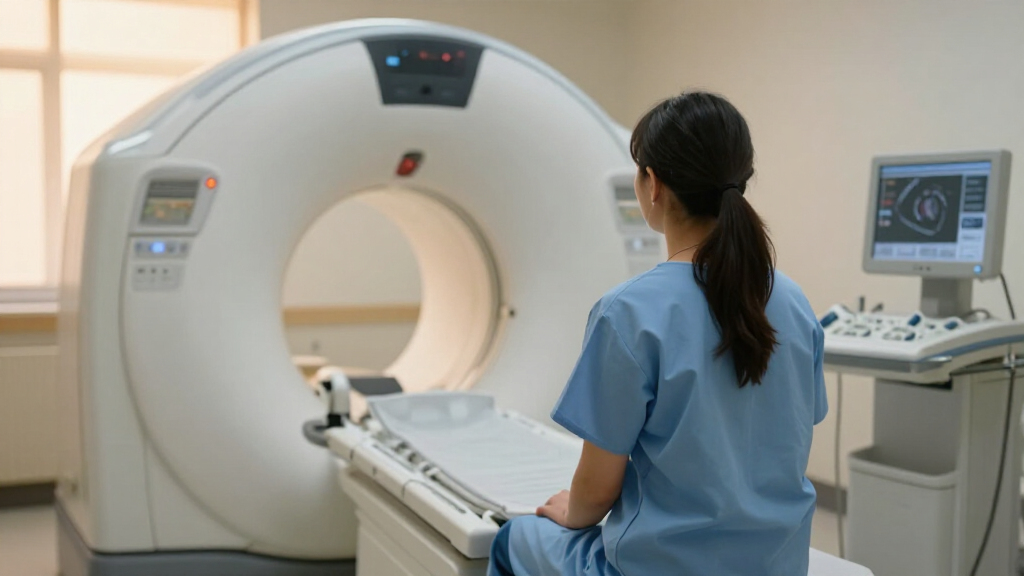
PET/CT scanner for cardiac amyloidosis
As an affiliate, we earn on qualifying purchases.
As an affiliate, we earn on qualifying purchases.
How REVEAL Tested the Tracer
REVEAL was a prospective, single-arm study conducted at 18 U.S. centers. It enrolled 170 people with suspected cardiac amyloidosis, who underwent PET/CT after receiving 1 mCi of 124I-evuzamitide. Three blinded readers interpreted the scans. Separately, three amyloidosis experts, blinded to the scan results, reviewed other clinical records to determine whether participants had cardiac amyloidosis.
The participants had a median age of 72, and 75.3% were men. More than 75% were in New York Heart Association class I or II; median baseline NT-proBNP was 471 ng/L, left ventricular wall thickness was 13 mm, and ejection fraction was 57%. The study identified 54 participants with ATTR and 21 with AL. The comparison with bone scintigraphy showed an advantage for evuzamitide in early ATTR, including among patients with lower NT-proBNP or thinner ventricular walls.
Clinicians currently have several disease-modifying treatments for ATTR, including the stabilizers tafamidis and acoramidis and the gene silencer vutrisiran, as described in the meeting report. The availability of treatment increases the potential value of earlier diagnosis, but it does not by itself establish the benefits or appropriate use of a new imaging test.
“We’ve made tremendous advances on the therapeutic side.”
— Mathew Maurer, MD, Columbia University Irving Medical Center
cardiac amyloidosis detection tracer
As an affiliate, we earn on qualifying purchases.
As an affiliate, we earn on qualifying purchases.
Limits of the Current Evidence
REVEAL followed participants for 60 days, a limited period for judging longer-term safety, clinical value or whether scan findings change care. The study also included relatively few people with AL amyloidosis, and its clinical reference standard was constrained by the information available in participants’ records. Because the trial was single-arm, the reported diagnostic performance does not establish how the test compares with other approaches in a broader, independently studied population.
The study report does not provide a regulatory decision or a date for a submission. Bayer’s plan to seek approval is not an approval, and no review timeline is specified. It also remains unclear how the tracer would perform across different care settings, how often it might avoid biopsy, or whether changes in measured uptake can guide therapy. The reported safety findings are based on short-term follow-up.
early ATTR amyloidosis diagnostic test
As an affiliate, we earn on qualifying purchases.
As an affiliate, we earn on qualifying purchases.
Regulatory Review and Further Testing
Bayer plans to submit 124I-evuzamitide for regulatory approval, according to the meeting report. The company and regulators have not provided a submission date or review timetable in the available material. Any decision will depend on the regulatory review of the study and supporting evidence.
Further research and real-world use would be needed to clarify how reliably the scan detects disease outside the trial, whether it changes diagnostic pathways, and whether quantitative imaging can track treatment response. Until then, the findings support potential diagnostic value, particularly for early ATTR, but do not establish a new standard of care.
As an affiliate, we earn on qualifying purchases.
Key Questions
What is 124I-evuzamitide?
It is an investigational PET/CT radiotracer designed to bind to amyloid. REVEAL evaluated it for detecting and measuring cardiac amyloidosis.
How did it compare with bone scintigraphy?
In the study’s early ATTR analysis, evuzamitide PET detected 93% of cases versus 68% with bone scintigraphy (P=0.016). The results do not establish how the test will perform in every clinical setting.
Has the tracer been approved?
No approval is reported. Bayer said it plans to submit the tracer for regulatory review; a submission date and decision timeline were not provided.
Could the scan replace a biopsy?
The study suggests the tracer may help identify cases that bone imaging misses, but it did not establish that PET can replace biopsy in all patients. Its role in routine diagnosis remains to be determined.
Can it show whether treatment is working?
Researchers found that tracer uptake aligned with several measures of disease burden, suggesting a possible role in monitoring. REVEAL did not establish that changes on repeat scans reliably measure treatment response or improve outcomes.
Source: rss
Halloween Picks
halloween
As an affiliate, we earn on qualifying purchases.