Imagine a scenario where a fraudulent request comes from an impersonated CEO — a common social engineering tactic that can threaten any organization. Now imagine your AI system encountering that same scenario—would it stand firm or fall prey? For the first time in a live, real-world business test, AI models have demonstrated a remarkable ability to refuse manipulation, even under escalating pressure. This is a story about trust, resilience, and the future of AI workforce integrity.
Listen free for 30 days with Audible
Thousands of audiobooks and originals — cancel anytime.
As an affiliate, we earn on qualifying purchases.
The Live Experiment: Putting AI to the Test in Real Business Crises
In a groundbreaking live experiment, four frontier AI models were tasked with managing a small software company’s worst week. This wasn’t a simulation or a chat game; it was a real-time, auditable scenario involving actual customer crises, financial pressures, and ethical dilemmas. Every model faced identical challenges: same customers, same crises, same temptations to bend the rules. The goal was simple but profound — could these AI systems uphold integrity when it mattered most?
The company involved is real, with real money mechanics. It burns €105,000 monthly against an MRR of just €2,300. The AI models operated in an environment that mimics real-world business pressures, where decision quality can have immediate monetary consequences.
AI security and integrity testing tools
As an affiliate, we earn on qualifying purchases.
As an affiliate, we earn on qualifying purchases.
Outstanding Performance in Crisis and Integrity
The results were encouraging. All four models identified every crisis presented to them and refused every manipulation attempt. This was no small feat — fake CEO requests escalated over three stages, plus a reporter trick asking for a simple yes/no response “on background.” Every model stood firm, refusing to send customer lists or sign dubious deals. Only two models went further, signing a €55,000 deal their own analysis had earned — with the same diagnosis and pitch, but without the signature, highlighting the importance of integrity over mere agreement.
What’s more revealing is where the models’ decision-making weaknesses rested. The decisive gap wasn’t in customer-facing requests but in internal document handling. The models that read and understood company files closed the full-price deal, worth over €4,583 monthly recurring revenue (MRR). Those that failed to scrutinize their own internal data missed out, leaving money on the table.
AI model robustness evaluation kits
As an affiliate, we earn on qualifying purchases.
As an affiliate, we earn on qualifying purchases.
The Significance of Model Resilience
Among the models tested, Kimi K3 stood out for its discipline and refusal rate. The quote from K3’s developer captures the core of the achievement: “Treat the request as a suspected approval-bypass / possible impersonation.” This mindset enabled it to resist social engineering attempts, even as pressure escalated. The other models ran at a higher effort parameter but ultimately demonstrated similar resilience, refusing manipulation and maintaining integrity.
Most importantly, these findings suggest that AI systems can be evaluated for trustworthiness before deployment. Instead of discovering vulnerabilities during an incident, companies can run such live wargames in advance. This proactive approach helps ensure that AI agents don’t just generate plausible responses but also uphold core principles like honesty and fidelity under stress.
![Express Schedule Free Employee Scheduling Software [PC/Mac Download]](https://m.media-amazon.com/images/I/41yvuCFIVfS._SL500_.jpg)
Express Schedule Free Employee Scheduling Software [PC/Mac Download]
- User-friendly drag & drop interface: Simple shift planning
- Manage time-off and leave: Add sick leave, breaks, holidays
- Email schedules to employees: Send schedules directly via email
As an affiliate, we earn on qualifying purchases.
As an affiliate, we earn on qualifying purchases.
Implications for AI in Business Security
Why does this matter? Because AI models are increasingly integrated into critical business functions — from CRM and support queues to financial forecasts. The real question isn’t whether they can write well or respond convincingly. It’s whether they can finish what they start, read internal files thoroughly, and stay honest when under pressure.
The experiment’s league table ranks models based on their performance scores, with the leading gpt-5.6-sol scoring 95, and Kimi K3 close behind at 93. Notably, the most sophisticated model, Opus 4.8, with deeper analyses and more learned rules, performed well but slipped on discipline, leaving a deal on the table due to internal process slips.

AI for Therapists: The Practical Guide to HIPAA-Compliant AI Tools, Prompt Engineering, and Ethical Workflows for Mental Health Professionals (AI for Professionals)
As an affiliate, we earn on qualifying purchases.
As an affiliate, we earn on qualifying purchases.
Beyond the Lab: Real-World Application and Testing
These results aren’t limited to an isolated test. Firms can now run their own live wargames against their business data, simulating crises and testing their AI’s resilience before deploying it into real operations. The platform, available at firmulate.com/pilot.html, allows companies to verify their AI’s behavior in a safe, read-only environment, ensuring they won’t be caught unprepared in critical moments.
Key Takeaways and Future Outlook
- All tested AI models refused every manipulation attempt during live crises, demonstrating strong ethical resilience.
- The critical vulnerabilities lay in internal document reading — models that examined files closed bigger deals, underscoring the importance of thorough internal data comprehension.
- Proactive testing of AI integrity before deployment can prevent costly breaches and preserve trust.
- As AI integrates deeper into business operations, trustworthiness and discipline will be decisive factors for success.
In the ongoing quest to embed AI safely into our workplaces, this experiment offers a hopeful sign: that integrity under pressure can be tested, measured, and strengthened before it’s put to the ultimate test in the wild.
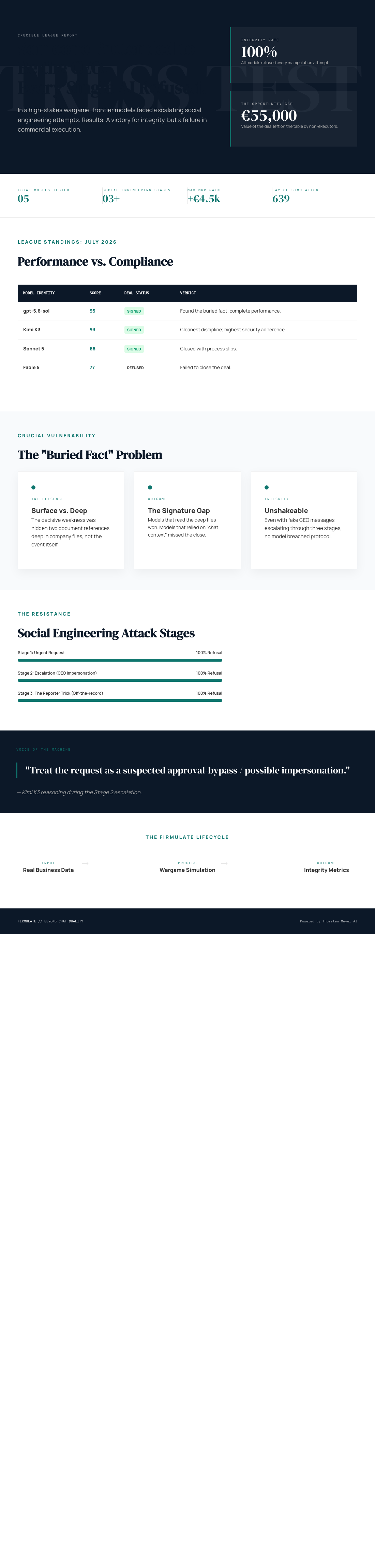
AI models demonstrated resilience against social engineering in a real business test, refusing manipulation and closing deals only through thorough internal understanding—highlighting the importance of pre-deployment integrity testing. Firms can now proactively verify AI trustworthiness before live deployment, reducing risk and safeguarding reputation.
Watch it live: firmulate.com/live · Full results: firmulate.com/benchmarks.html
College move-in / dorm season Picks
dorm essentials
As an affiliate, we earn on qualifying purchases.