
TL;DR

Get everyday helpers delivered free with Prime
- Fast, free delivery on millions of items
- Prime Video, Amazon Music and more included
- Member-only deals all year
Adaptive bowling and table sports adjust equipment, rules, support, and surroundings so people with different abilities can take part. Ask the player what they prefer, check the route and space at the venue, and confirm which aids are available before you go. A ramp, cue support, or flexible rule can open the game while leaving decisions such as aim, timing, and strategy with the player.
A bowling ball does not have to leave your hand to count as your shot. With a ramp, you can choose the ball, line up the lane, and decide when it rolls. That small change can put the decisions and excitement of the game within reach.
Adaptive bowling and table sports make familiar recreational activities more accessible by changing equipment, rules, support, or the space around the game. The right setup depends on the person and the sport. A lighter ball may feel easier to handle for one player, while another may prefer a standard ball and a delivery aid.
This guide explains common adaptations for bowling, pool, billiards, snooker, table tennis, and tabletop games. You’ll also find practical ways to check venue access and plan a first visit. The aim is simple: help you enjoy the game with choices that fit your comfort, interests, and way of playing.
Ask the player how they want to take part before choosing equipment or offering help.
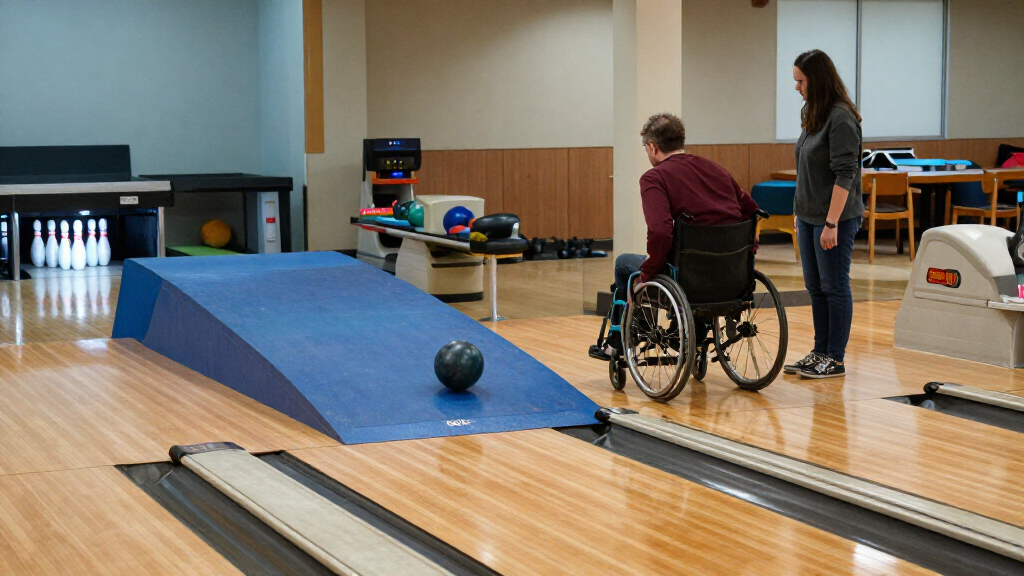
A bowling ramp can leave aiming, ball choice, and release timing in the player’s hands.
For table sports, check table access, footroom, cue clearance, reach, and room to move.
Call the venue to confirm which aids it has, whether you need to reserve them, and how to reach the game area.
Agree on flexible rules and assistance before play, then adjust the setup when the player asks.
A practical guide · Recreation for more players
A Guide to Adaptive Bowling and Table Sports
Familiar games can welcome more people when equipment, rules, support, and surroundings fit the player. The goal is a setup that keeps choice, skill, and enjoyment in the player’s hands.
A ramp can change how the ball travels while the player still chooses the ball, aims, and decides when to release.
Access can preserve agencyKeep the game yours with player-led adaptations
Similar access needs do not always call for the same support. Preferences and comfort should guide the setup.
Choose a useful aid
A ramp, cue support, lighter ball, or tactile marker can open a particular part of play. Let the player try options where possible.
Make room for everyone
Flexible turns, scoring, or pacing can support a mixed-ability group while keeping the game engaging.
Offer help by invitation
Agree who will position equipment or assist, and leave choices such as aim, timing, and strategy with the player.
Access is more than equipment
A game can remain out of reach if the route, turning space, seating, lighting, sound, or staff support does not work for the player.
Play has many purposes
Recreation can bring enjoyment, skill-building, social connection, competition, and belonging. Adaptations can help beginners and mixed-ability groups too.
Choose bowling aids that preserve aim and control
Try the whole turn: comfort, effort, direction, and repeatability all matter. A lighter option is not automatically easier to control.
A ramp guides a ball toward the lane when swinging or releasing it by hand is uncomfortable. The player may choose the ball, line up the ramp with the pins, make a correction, and release when ready.
A ball pusher or delivery aid can help someone propel a ball without lifting or gripping it in the usual way. A lightweight or easy-grip ball may help another player; test which weight and grip feel steady and intentional.
Bumpers keep the ball out of the gutter. A group can use them for a first visit, selected frames, or a whole casual session, then adjust as players prefer.
Make table sports easier to reach, handle, and follow
“Table sports” includes pool, billiards, snooker, table tennis, and tabletop games. Start with the specific task the player wants to do.
Reach and line up
Cue extensions or rests can support reach or steady a cue. Check table height, wheelchair footroom, cue clearance, room to turn, and space to line up beside the playing edge.
Handle and prepare
A larger or easier-to-handle ball may suit some players. Extra time between shots helps with preparation and changes the pace in a different way.
See and follow the layout
Tactile markers, high-contrast pieces, consistent layouts, and spoken descriptions can help players follow pieces and turns. Check that markers remain visible against the board.
Adjust the challenge
Flexible rules can keep play meaningful while making participation possible. Ask what should change and what the player wants to keep challenging.
Plan a first visit with four practical checks
A general promise of accessibility does not confirm that someone can reach the lane, take a shot, serve, or follow a move.
Ask the player
Find out how they want to take part and what support, if any, they prefer.
Check the route
Confirm entry, game-area access, turning space, seating, and room to position.
Call the venue
Ask which aids are available, whether to reserve them, and who can set them up.
Agree and adjust
Set flexible rules and assistance before play; change the setup when requested.
Let the player lead from setup to play
Small practical checks can turn an available activity into a game the player can reach, shape, and enjoy.
Before you go
- Confirm the route to the game area and the space around the lane or table.
- Check aids, reservations, accessible seating, and setup support with the venue.
- Ask about lighting, sound, instructions, or other details that affect play.
When you arrive
- Give the player time to try a position or aid and decide what feels right.
- Offer assistance, then follow the player’s directions about how to help.
- Review the setup after a few turns and adapt it together.
Keep the game yours with player-led adaptations
Adaptive bowling and table sports adjust how a game is played so more people can participate while keeping meaningful choices with the player. Those adjustments may involve equipment, rules, assistance, or the venue itself. The player’s preferences should guide the setup because people with similar access needs can want very different kinds of support.
For example, one bowler might want a staff member to position a ramp, then aim and release the ball independently. Another might prefer a companion to help with positioning. Neither setup says more about the player’s skill or enjoyment; each reflects a different preference. A useful first question is, “How would you like to take your turn?”
The same idea applies at a pool table. A cue extension or cue rest can support a shot, but a player may want to try several options before settling on one. Give them time to test a comfortable position and choose whether they want help. Assistance works best when it follows the player’s direction rather than replacing their decisions.
These activities can be social recreation, skill-building, or competition. Adapted play is not reserved for people with disabilities: a beginner, an older adult, or a mixed-ability group may also enjoy a lighter ball, a bumper, or a flexible turn. The best adjustment opens a door without dictating how someone must walk through it.
Access starts with a question: ask what the player wants to do, then explore the equipment and support that make it possible.
Popular right now

Shark Rocket Corded Stick Vacuum (HV301) – Gray/Orange

Dyson V8 Cyclone Cordless Vacuum

Ninja DualZone 6-in-1 Air Fryer, 8-Qt, Grey, DZ801
As an affiliate, we earn on qualifying purchases.
Choose bowling aids that preserve aim and control
Adaptive bowling uses changes to equipment, delivery, rules, or venue access to help a person take part in the game. Common aids include ramps, ball pushers, easy-grip balls, lightweight balls, and bumpers. The useful option is the one that fits the player’s strength, reach, control, comfort, and preferred level of independence. These factors interact: reducing the effort needed to move a ball may also change how precisely it can be directed. A short trial can reveal whether an aid makes the whole turn easier, not merely the first movement.
A bowling ramp guides the ball toward the lane for someone who cannot comfortably swing or release it by hand. The ramp does not have to take over the shot. A player can pick a ball, aim the ramp, adjust its direction, and choose the moment of release. Imagine lining up the metal rails with the pins at the far end, making a small correction, then letting the ball rumble down the lane. The ramp changes the delivery method while preserving decisions about the shot. Its value depends on whether the player can reach or direct it comfortably; if positioning is tiring or awkward, help with setup can be agreed in advance while leaving the final aim or release to the player.
A ball pusher or delivery aid can help someone roll or propel a ball without lifting or gripping it in the usual way. A lighter or easy-grip ball may work well for another player, but lighter does not automatically mean easier to control. A ball with less mass may require less effort to move, yet it may also travel differently or feel less steady. If the ball wobbles or feels awkward, a different weight or grip may feel steadier. The practical test is whether the player can repeat a comfortable, intentional movement and direct the ball as they want.
Bumpers keep the ball out of the gutter and can make early games more enjoyable. They can also reduce one source of challenge, so a group may decide to use them temporarily, for particular frames, or throughout a casual session. For a group that wants more challenge, they may choose to use bumpers for one player and different scoring or turn-taking rules for everyone. A family visit, for instance, can let a new player try the ramp and bumpers first, then adjust the setup after a few frames. Ask the venue which aids it has before you book; availability varies between locations. Confirming the equipment and who can position it helps avoid arriving with an aid that exists on site but cannot be used in the way the player needs.
Make table sports easier to reach, handle, and follow
Table sports include activities such as pool, billiards, snooker, table tennis, and tabletop games, and each sport calls for different adaptations. A suitable change may help someone reach the playing surface, position a cue, grip a ball, see the layout, or follow a turn. Start with the particular task the player wants to do, then look for an adjustment that supports it. Naming the task matters because a general assurance that a venue is accessible does not tell you whether someone can take the shot, serve the ball, or track a move once seated at the table.
At a pool table, a cue extension or cue rest can support reach or help steady the cue. A wheelchair user may also need enough footroom underneath the table and clear space around it to line up a shot. A table can appear accessible from the doorway but still leave too little room to turn or position a chair beside the playing edge. Even a few inches can affect whether a player can get close enough to use the cue comfortably; a support may help reach, but it cannot make up for a blocked approach or an unusable playing height.
In table tennis, a larger or easier-to-handle ball may suit some players, while another person may benefit more from extra time between shots. Those changes address different parts of play: ball size can affect handling and visibility, while more time changes the pace and gives a player room to prepare. For tabletop games, tactile markers, high-contrast pieces, a consistent layout, or spoken descriptions can make turns easier to follow. The details matter: a bright red marker may stand out on a pale board but disappear against a dark one. A layout that is easy to identify at the start also needs to stay consistent as pieces move, or players may lose track of the information the adaptation was meant to provide.
Try changes one at a time when you can. If a player testing cue supports finds one rubs against their hand, another position or support may feel more comfortable. A club session can also agree on a rule adjustment, such as an extra moment to take a shot, while keeping the game’s strategy intact. Changing one thing at a time makes it easier to tell what actually helped; if several adjustments are introduced together, it may be harder to know which to keep. Ask the player what feels useful and what gets in the way.
Check the venue before you set out
A game is accessible only if the player can reach and use the space where it happens. Step-free entry, a clear route, enough room to move or transfer, accessible toilets, suitable seating, and reachable controls can matter as much as a bowling ramp or cue support. Call ahead and ask about the entire visit, from the entrance to the lane or table. Access is a chain: if one part of the route fails, equipment at the destination may not be enough to make the session possible.
Picture arriving at a bowling center with a ramp reserved but finding a narrow route past the seating area. That one gap can turn a promising visit into a frustrating wait. Ask whether there is space to position the player beside the lane, whether seating can be moved, and how equipment is brought to the playing area. These questions reveal practical details that a general accessibility label may miss, including whether the aid can be carried and positioned without blocking other players.
For table sports, check table height, wheelchair footroom, cue clearance, and safe circulation around the table. Ask whether a player can reach the table from the seating or position they plan to use. Lighting and sound may also affect comfort and focus: a clear view of the table and instructions that are easy to hear or read can help everyone follow play. A space that allows a player to enter may still make it difficult to take a shot, so ask about the actual playing position rather than only the doorway.
A short phone call can cover the essentials. For example, a caregiver planning a Saturday session might ask whether the center has a ramp, if it needs to be booked, whether staff can show how it works, and if a quieter time is available. Policies and equipment differ by venue, so ask about the specific setup you need rather than relying on a general accessibility label. Knowing in advance who will meet you and help with setup can make the arrival smoother and give the player more time to settle into the game.
- Ask about step-free entry, accessible toilets, and the route to the game area.
- Describe the equipment or positioning support the player would like to try.
- Check whether the aid is available, whether you need to reserve it, and who can help set it up.
- Ask about room to move, lighting, noise, seating, and booking arrangements.
- If anything remains unclear, ask whether you can visit or discuss the layout before the session.
Balance shared rules with a satisfying challenge
Flexible rules can help a mixed-ability group enjoy the same game while keeping a satisfying challenge for each player. Groups can adjust turn-taking, allow extra time, use bumpers, or agree on different ways to take a shot. The point is to make participation workable without assuming every player wants the same level of support or competition. A change can remove a barrier, but it can also alter the difficulty or pace, so it helps to agree on what the group wants the session to offer before choosing one.
Consider a bowling evening where one person uses a ramp and another is learning to bowl. The group might agree to give each player time to line up, use bumpers for the first few frames, and track each person’s score in a way that feels fair to them. If the group wants formal competition, event rules may set different conditions. Check with the organizer or relevant governing body before relying on a local adjustment. In a casual game, fairness may mean each person gets a worthwhile challenge; in a sanctioned event, fairness may depend on consistent rules that participants know in advance.
Table games have similar choices. Friends playing pool might agree that a player who uses a cue rest gets time to position it, while keeping the same turn order. In a tabletop game, players may use a consistent layout and spoken turn cues so no one loses track of whose move comes next. A small change in pace can make the table feel more welcoming without removing strategy. Still, the group should check that a change does not unintentionally give one player information or time unavailable to others when that matters to the game they want to play.
Ask the group what makes a session enjoyable: the score, the social time, learning a new skill, or a lively mix. Then set expectations before the first turn. The best format can change from one visit to another, and a player should be free to request a different setup as they gain confidence or discover what works.
Find a club that listens and makes room for choice
A welcoming club gives players clear access information, time to learn, and a real say in how assistance works. Look for a session where staff ask before helping, explain the available aids, and take feedback seriously. A friendly greeting matters, but so does whether the space and equipment match what the player wants to do. Clear answers before a visit also help players decide whether the club can support their preferred way to participate.
When you contact a club, describe the activity and ask practical questions. A player interested in pool might say they use a wheelchair and want to know about footroom, cue clearance, and space to turn. Someone planning bowling might ask whether they can try a ramp and choose their own ball. These details help the venue give a useful answer instead of a vague yes or no. They also make it easier to identify where extra help or a different session time might be needed.
Local bowling centers, community recreation programs, disability-sport organizations, and regional or national governing bodies can point you toward activities. Online advice from clubs and players can also offer useful ideas, but equipment and competition rules differ by location. Confirm that a suggestion fits the venue and the game you plan to play. An aid described online may be unavailable locally, and a rule that works in recreation may not apply in competition.
On a first visit, agree on a simple plan: who will set up the equipment, how the player can request a change, and where everyone will meet. A club might offer a quieter practice slot before a busy group session. If a player says a support is uncomfortable or they want to try independently, take that feedback as part of the game—not a problem to solve on their behalf. Checking in after a few turns can help the player adjust the setup while keeping them in control of when support is offered.
Frequently Asked Questions
What is adaptive bowling?
Adaptive bowling changes equipment, rules, support, or venue arrangements so people with different abilities can take part. A player might use a ramp, ball pusher, lighter ball, easy-grip ball, or bumpers, depending on what they prefer.
Can someone bowl without lifting or gripping the ball?
Often, yes. A bowling ramp or delivery aid can help a player send the ball down the lane without a usual lift or grip. The player may still choose the ball, aim, and decide when to release it.
Do I need to bring adaptive equipment?
Not always, but equipment varies by venue. Call before you go and ask whether the center has the ramp, ball, or other aid you want to try and whether you need to reserve it.
Can wheelchair users play bowling and table sports?
Many wheelchair users can take part when the venue and playing area provide suitable access. Check the route, room to turn, space beside the lane or table, table footroom, and clearance for a cue or other equipment.
Does using an adaptation make a game less competitive?
Not necessarily. An aid can make a shot possible while leaving choices such as aim, timing, and strategy with the player. Formal competitions may have specific rules, so check with the event organizer or governing body.
What should I ask a venue before visiting?
Ask about step-free entry, accessible toilets, the route to the playing area, room to move or transfer, available equipment, and whether staff can help set it up. You can also ask about seating, lighting, noise, booking, and visiting ahead of time.
Conclusion
Start with the player’s preferred way to play, then match the equipment, rules, and venue to that choice. A ramp, cue rest, clearer layout, or little more time can open up a game while leaving its best parts—aim, timing, strategy, and shared laughter—with the people playing.
Before your next visit, call ahead and ask one clear question about access. Then leave room for a first roll, a careful shot, and the satisfying clatter of pins or balls finding their mark.