
TL;DR

Get everyday helpers delivered free with Prime
- Fast, free delivery on millions of items
- Prime Video, Amazon Music and more included
- Member-only deals all year
NATIVE-ID, a multi-institutional research project led by the Innovative Genomics Institute at UC Berkeley, aims to use experimental data and AI to study early protein dysfunction. Stowers Institute researcher Randal Halfmann’s lab is set to receive about $4.1 million over two years to measure aggregation in 50,000 proteins; whether the resulting models can predict disease in people remains unproven.
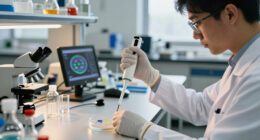
A new multi-institutional project backed by the Advanced Research Projects Agency for Health aims to gather data on how proteins begin to malfunction and use it to train artificial intelligence models. The effort, called NATIVE-ID, will include experiments on 50,000 proteins by Randal Halfmann’s lab at the Stowers Institute for Medical Research, with the broader goal of improving understanding of early protein dysfunction associated with neurodegenerative diseases.
Halfmann’s lab has been selected to generate experimental data on protein aggregation and is expected to receive about $4.1 million over two years from ARPA-H. The project expects to test each of 50,000 proteins in yeast cells under a range of conditions intended to model changes that can occur in human cells as they age. The team estimates it will analyze more than 1 million samples and produce over 10 billion measurements.
The lab will use Distributed Amphifluoric FRET, or DAmFRET, a method developed by Halfmann’s team in 2018 to measure protein self-assembly inside individual living cells. The research is intended to examine how differences in amino-acid sequences affect whether proteins remain in their usual state or aggregate. The project’s organizers say large-scale experimental data of this kind could help address a gap in the information available to train AI models.
NATIVE-ID is led by the Innovative Genomics Institute at the University of California, Berkeley and is part of ARPA-H’s BIOGAMI program. Participating institutions also include Brown University, Emory University, Johns Hopkins University, Texas A&M University, the Parallel Squared Technology Institute and Stowers. The initial disease focus is frontotemporal lobar degeneration, or FTLD, which shares genetic and biological features with ALS.
Building Data for Disordered Proteins
The project addresses a limitation in current protein-prediction research. Many AI advances have focused on predicting stable protein structures, but the source report says roughly one-third of proteins lack a stable structure. These intrinsically disordered proteins can shift among different shapes, and some can form aggregates associated with neurodegenerative disease. Their changing behavior makes them difficult to study and model.
If the researchers can link sequence changes to aggregation behavior, the resulting data may help scientists develop models that estimate when particular proteins are likely to malfunction. Halfmann said such predictions could potentially help people seek preventive or early-stage treatments or join clinical trials. That is a prospective benefit, not a demonstrated outcome: the project has not established a clinical prediction tool or shown that its approach improves treatment.
The collaboration pairs experiments in yeast with work by other team members involving human neurons, according to the account. That combination matters because measurements in a simpler experimental system will need to be tested against human-cell biology before researchers can judge how well they apply to disease. The project’s value will depend not only on the volume of data, but also on whether model predictions hold up in those later tests.
As an affiliate, we earn on qualifying purchases.
From Earlier Protein Studies to NATIVE-ID
Protein misfolding and aggregation are associated with several neurodegenerative diseases, including Alzheimer’s, Parkinson’s, ALS and Huntington’s disease. The project is focused first on FTLD, rather than claiming to address all of these conditions at once. Its organizers describe the longer-term goal as developing methods that could apply across diseases involving protein misfolding.
NATIVE-ID builds on earlier work by Halfmann’s group. In 2023, the lab reported experimentally determining the structure of an initiating step in amyloid formation associated with Huntington’s disease. The team has also studied TDP-43, a protein associated with ALS and FTLD. Halfmann described those investigations as pilot work involving hundreds of protein sequences; the new project will expand the scale to tens of thousands.
The project is part of BIOGAMI, an ARPA-H program bringing together different research approaches to understand and potentially control harmful protein aggregation. ARPA-H Program Manager Shannon Greene leads that broader program. The available project description does not establish that NATIVE-ID will produce a treatment; its stated work centers on experiments, data generation and AI model development.
“If we can better predict the probabilities and onset ages of disease, it could allow many more people to seek preventive or early-stage treatments or enroll in clinical trials.”
— Randal Halfmann, Stowers Institute investigator
neurodegenerative disease research tools
As an affiliate, we earn on qualifying purchases.
As an affiliate, we earn on qualifying purchases.
Prediction Still Needs Human Tests
The announced measurements and funding describe planned research, not confirmed results. It remains unclear how accurately an AI model trained on the data will predict protein dysfunction, whether predictions from yeast experiments will carry over to human neurons, or whether any model could estimate disease onset for individuals.
The source account does not give a project completion date or specify when models or datasets will be released. It also does not report clinical testing, patient outcomes or a treatment arising from the work. The estimated measurement totals are project expectations, not completed counts.
As an affiliate, we earn on qualifying purchases.
Experiments and Model Validation
The immediate work is to run the planned yeast-cell experiments, measure aggregation across protein sequences and generate data for AI training. Other NATIVE-ID collaborators are expected to contribute complementary capabilities, including work with human neurons, where the team can examine whether model predictions are relevant in a human-cell setting.
Further updates will need to show how the data are collected, what the models predict and how those predictions perform in validation experiments. Until then, NATIVE-ID is a research effort aimed at building a foundation for studying early protein dysfunction, not a diagnostic service or a treatment program.
As an affiliate, we earn on qualifying purchases.
Key Questions
What is the NATIVE-ID project?
NATIVE-ID is a multi-institutional research project led by the Innovative Genomics Institute at UC Berkeley. It aims to study disordered proteins by combining large-scale experiments with AI model development.
What will Halfmann’s lab measure?
The Stowers Institute lab plans to test how 50,000 proteins behave in yeast cells, using DAmFRET to measure self-assembly and aggregation under varied conditions.
Does the project already predict who will develop dementia or ALS?
No. The project is intended to generate data and develop models for research. The announcement does not report an individual risk-prediction tool, clinical validation or patient results.
Which disease will the project study first?
The team plans to focus initially on frontotemporal lobar degeneration, which shares genetic and biological features with ALS. The broader research goal is to inform work on other diseases involving protein misfolding.
Source: rss
Fall Picks
fall essentials
As an affiliate, we earn on qualifying purchases.