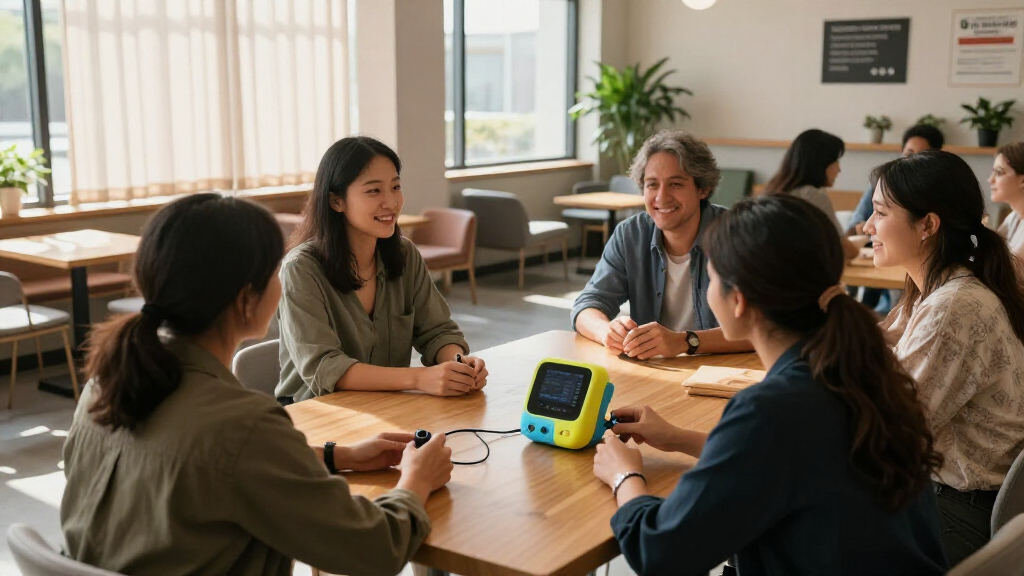

📊 Full opportunity report: Creating A Civic Engagement Logistics Space That Inspires Participation on IdeaNavigator AI — validation score, market gap, and execution plan.

Get everyday helpers delivered free with Prime
- Fast, free delivery on millions of items
- Prime Video, Amazon Music and more included
- Member-only deals all year
TL;DR
A nonprofit is testing a guided logistics workspace designed for citizens’ assembly organizers. The tool aims to simplify participant recruitment, scheduling, and reporting, addressing a key scalability challenge in civic engagement efforts.
A civic-dialogue nonprofit is testing a new logistics workspace designed to streamline the planning process for citizens’ assemblies. This initiative aims to address the manual and fragmented workflows currently used by coordinators, potentially enabling more scalable and efficient civic engagement programs.
The project involves developing a guided event-operations platform that takes a dialogue cohort from participant recruitment through demographic balancing, facilitator scheduling, and final reporting. The tool is intended to replace the current reliance on spreadsheets and email communication, which can be inefficient and error-prone.
According to an anonymous source involved in the project, the initial phase involves recruiting five coordinators planning upcoming forums. Their manual workflows—such as creating participant rosters, scheduling sessions, and tracking attendance—are being simulated within the proposed platform to evaluate its usability and value.
The platform would operate on a subscription model, billed per program, making it accessible for small nonprofits and civic organizations that currently lack scalable logistic solutions. The goal is to validate whether coordinators find the tool useful enough to pay for continued use.
Potential Impact on Civic Engagement Scaling
If successful, this logistics workspace could significantly improve the efficiency of organizing deliberative forums, enabling nonprofits to run more assemblies with less administrative overhead. This could lead to broader community participation, especially in regions where manual planning limits the number and quality of civic dialogues.
As funders and local governments increasingly support citizens’ assemblies, the need for scalable, purpose-built logistical tools becomes more urgent. A successful pilot could influence how civic programs are organized nationwide, fostering more inclusive and representative deliberative processes.
participant recruitment management software
As an affiliate, we earn on qualifying purchases.
As an affiliate, we earn on qualifying purchases.
Growing Demand for Scalable Civic Engagement Tools
The rise of citizens’ assemblies and deliberative panels has created a need for specialized logistical tools. Currently, many organizations rely on ad hoc methods like spreadsheets, email, and manual scheduling, which are difficult to scale. This challenge is especially acute for small nonprofits that deliver civic dialogues without dedicated software solutions.
Funders and governments are commissioning more of these forums, but the capacity of small organizations to meet demand remains limited by inefficient workflows. The proposed logistics workspace aims to fill this gap by providing a guided, scalable platform that simplifies key planning tasks.
This initiative aligns with broader trends toward digital transformation in civic engagement, where technology is used to make participation more accessible and manageable.
“The current process is just a jumble of spreadsheets and emails. Having a dedicated workspace could really change how we organize these forums.”
— an anonymous project participant
event scheduling platform for civic engagement
As an affiliate, we earn on qualifying purchases.
As an affiliate, we earn on qualifying purchases.
Uncertainties Around Effectiveness and Adoption
It is not yet clear how well the platform will perform in real-world settings or whether coordinators will find it sufficiently valuable to pay for long-term use. The pilot is still in early testing, and broader adoption depends on user feedback and demonstrated efficiency gains.
Additionally, questions remain about how adaptable the tool will be to different types of civic forums and organizational sizes. Further validation is needed to confirm its scalability and impact.
attendance tracking tools for meetings
As an affiliate, we earn on qualifying purchases.
As an affiliate, we earn on qualifying purchases.
Next Steps for Validation and Broader Testing
The project team plans to complete initial testing with the five recruited coordinators over the next few months, gathering detailed feedback on usability and perceived value. If results are positive, they will move toward refining the platform and launching a broader pilot involving more organizations.
Further development may include integrating additional features such as participant engagement tracking and post-event analytics. The goal is to establish a proof of concept that can be scaled for wider civic engagement efforts.
civic engagement reporting software
As an affiliate, we earn on qualifying purchases.
As an affiliate, we earn on qualifying purchases.
Key Questions
How does the logistics workspace improve upon current methods?
The platform consolidates participant recruitment, demographic balancing, scheduling, and reporting into a guided workflow, replacing manual, error-prone processes like spreadsheets and email chains.
Who will have access to this platform?
The initial focus is on small civic-dialogue nonprofits and organizations planning citizens’ assemblies, with a subscription model tailored to their needs.
Is this platform ready for widespread use?
The platform is currently in early testing with a small group of coordinators. Broader availability will depend on successful validation and user feedback.
Will this tool be adaptable for different types of civic forums?
That remains to be tested. The initial design aims to be flexible, but further development will be needed to confirm adaptability for diverse formats and scales.
What are the main challenges ahead?
The key challenges include demonstrating clear efficiency gains, securing user buy-in, and scaling the platform to meet varied organizational needs.
Source: IdeaNavigator AI
Columbus Day / Indigenous Peoples' Day Picks
long weekend sales
As an affiliate, we earn on qualifying purchases.